
FAQs
Safety In Paradise is a free consultation program that offers professional advice and help in addressing immediate problems and maintaining continued effective worker protection. Employers can find out about potential hazards at their worksites, improve their occupational safety and health management systems, and even qualify for a one-year exemption from routine OSHA inspections.
No. Safety In Paradise Consultants are not part of OSHA Enforcement and cannot issue citations to businesses found in non-compliance.
Employers have the responsibility to provide a safe workplace. Employers MUST provide their workers with a workplace that does not have serious hazards and must follow all OSHA safety and health standards. Employers must find and correct safety and health problems. OSHA further requires that employers must first try to eliminate or reduce hazards by making feasible changes in working conditions rather than relying on personal protective equipment such as masks, gloves, or earplugs. Switching to safer chemicals, enclosing processes to trap harmful fumes, or using ventilation systems to clean the air are examples of effective ways to eliminate or reduce risks.
No. Employees cannot contact Safety In Paradise directly, however, they are encouraged to raise health and safety concerns with their representatives and employers.
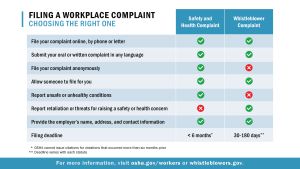
Workers (or their representatives) have the right to file whistleblower complaints and/or confidential health and safety complaints – reporting injuries, safety issues, and actions taken against them for speaking up including being fired, demoted, or disciplined – and request an OSHA inspection of their workplace if they believe there is a serious hazard or if they think their employer is not following OSHA standards.
File a complaint online, or utilize one of the other methods available on the official OSHA website.
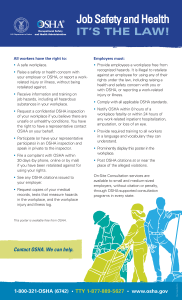
All covered employers are required to prominently display the official OSHA “Job Safety and Health – It’s the Law” poster, that describes workers’ rights and employers’ responsibilities under the Occupational Safety & Health (OSH) Act, where workers can see it. Federal government agencies must use the Federal Agency Poster. Employers do not need to replace previous versions of the poster.
The OSHA poster (OSHA 3165) is available for free, in multiple languages from the OSHA Office of Publications.
You can get information on health and safety hazards in the workplace either by searching the Health and Safety Topics page on OSHA’s website at http://www.osha.gov/SLTC/index.html by topic or by looking up specific hazards in OSHA’s A-Z Index (http://www.osha.gov/html/a-z-index.html).
On January 1, 2003 OSHA began using the North American Industry Classification System (NAICS) for industry identification in its various data sets.
NAICS uses a six digit hierarchical coding system to classify all economic activity into twenty industry sectors. Five sectors are mainly goods-producing sectors and fifteen are entirely services-producing sectors. This six-digit hierarchical structure allows greater coding flexibility than the four digit structure of the Standard Industrial Classification (SIC) system. NAICS allows for the identification of 1,170 industries compared to the 1,004 found in the SIC. For detailed information on the NAICS coding structure please visit the U.S. Census Bureau.
The Standard Industrial Classification has been replaced by the North American Industry Classification System (NAICS), but several OSHA data sets are still available with SIC-based data. For information on the Standard Industrial Classification system, please visit Standard Industrial Classification (SIC) System Search.

Many employers with more than 10 employees are required to keep a record of serious work-related injuries and illnesses using OSHA Form 300: Log of Work-Related Injuries and Illnesses, OSHA Form 300A: Summary of Work-Related Injuries and Illnesses, and OSHA Form 301: Injury and Illness Incident Report. Certain low-risk industries are exempted.*
The records must be maintained at the worksite for at least five years. Each February through April, employers must post a summary of the injuries and illnesses recorded the previous year. Also, if requested, copies of the records must be provided to current and former employees, or their representatives.
* Note: The list of partially exempt industries is based on the 2007 NAICS codes. If an industry listed on the “Non-Mandatory Appendix A to Sub part B – Partially Exempt Industries” no longer exists in the 2017 and 2022 NAICS coding system, this would not change your partially exempt status. {See OSHA FAQ 2-3 and 2-4}.
Get more information on recordkeeping forms 300, 300A & 301, and additional instructions.
Learn more about what injuries need to be reported.
St. Thomas
St. Croix
